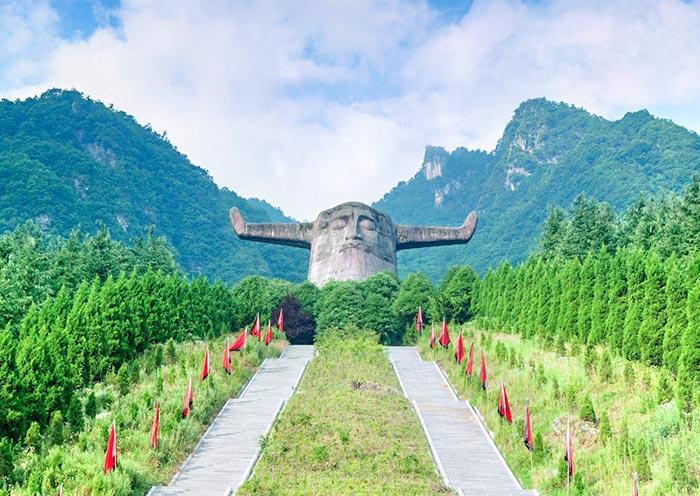
Imagine walking through an ancient forest where towering trees disappear into thick mountain fog, waterfalls tumble down enormous rocky cliffs and mysterious sounds echo through the wilderness. There are no crowded shopping streets or towering skyscrapers here, only mountains, wildlife and the breathtaking silence of nature. Welcome to Shennongjia, one of China's most remarkable yet lesser-known adventure destinations.
Located in Hubei Province in central China, Shennongjia is a vast mountainous region that feels like a world untouched by modern civilisation. Its dramatic landscape includes deep valleys, alpine meadows, dense forests and spectacular mountain ridges. The highest peak, Shennongding, rises approximately 3,106 metres above sea level, making it the highest mountain in central China.
For adventure travellers, the journey into Shennongjia is an opportunity to experience a completely different side of China. Instead of exploring busy urban attractions, visitors can discover mountain trails, explore forest landscapes, photograph dramatic waterfalls and witness extraordinary natural scenery. The region's changing elevations create different environments, from subtropical forests to cold mountain grasslands.
One of its most enchanting attractions is Dajiu Lake, a collection of beautiful alpine wetlands surrounded by mountains. Early in the morning, mist floats above the water, creating an almost dreamlike landscape. The reflection of distant mountains across the wetlands makes it a spectacular destination for photographers, hikers and nature enthusiasts.
But Shennongjia's greatest treasure is perhaps its wildlife. The forests provide shelter for some of China's rarest animals, including the endangered golden snub-nosed monkey, Asian black bear, clouded leopard and Chinese giant salamander. The golden snub-nosed monkey, with its striking golden fur and distinctive blue face, is particularly fascinating. Shennongjia is one of the most important places for protecting this rare primate.
The region is also internationally recognised for its extraordinary biodiversity. In 2016, Hubei Shennongjia was added to the UNESCO World Heritage List because of its exceptional forests, rare species and ecological importance. Its protected landscapes contain thousands of plant species and hundreds of recorded vertebrate species, making it one of China's most valuable natural sanctuaries.
Beyond its wildlife and mountain scenery, Shennongjia carries an atmosphere of mystery. Local folklore has long told stories of a legendary wild man said to inhabit the remote forests. Sometimes compared with the Himalayan Yeti, the mysterious creature has inspired explorers, researchers and curious travellers for generations. Although no credible scientific evidence has established the existence of such a creature, the legend adds another layer of fascination to this already extraordinary wilderness.
Adventure seekers can explore scenic mountain routes, discover forest viewpoints and experience the changing landscapes around Shennongding. Visitors can also explore the waterfalls and natural formations around Tianshengqiao, while the Guanmenshan area offers opportunities to learn about the region's remarkable biodiversity. Because much of the landscape is protected, travellers should follow designated trails and local park guidance rather than venture into restricted wilderness areas.
The best experience is often found in the quiet moments: watching clouds drift across distant mountain peaks, listening to birds calling through ancient trees or seeing morning sunlight slowly illuminate the forest.
Shennongjia is not simply another beautiful destination on China's travel map. It is a reminder that extraordinary adventures still exist in places where nature remains the main attraction. For travellers searching for something beyond ordinary sightseeing, this forgotten wilderness offers a rare opportunity to discover the mysterious beauty of China's mountains.
Sometimes, the greatest adventure is not about reaching the most famous destination. It is about finding a place where the world still feels wonderfully unexplored.